On Cathedrals
Cathedrals are my favorite kind of building, and I am here to explain why.
Cathedrals are the ideal pinnacle of human creation solely because of the pure ingenuity that comes from its creation. I got hyperfixated on Cathedrals a year or so ago, and in this year I dove headfirst into the construction, history and several types of Cathedrals that exist on Earth. The thing that stood out to me the most was the process of creating one followed by the actual artistic impact that Cathedrals had on history. As I am a hobbyist in architecture, and I have only been interested in this topic for a minimal amount of time, there has only been time to focus on Gothic Architecture, though in the future perhaps I shall research Romanesque Cathedrals in the future.
In fact, building a Cathedral itself often was its own several year long effort that spawned essentially mini cities where it was planned on being built. That's just so fascinating, that the existence of these buildings lead to entire temporary societies.
There's a lot of functions a Cathedral holds. It houses religious figures, it served as a place of worship, it served as a place where monks could scribe any sort of literature or writing. For the longest time, a Cathedral was the center of a community, and I find that the effort that went into the building oft is reflective of the historical communal impact, and I aim to explore all of these topics today.
Anatomy of a Cathedral - Interior
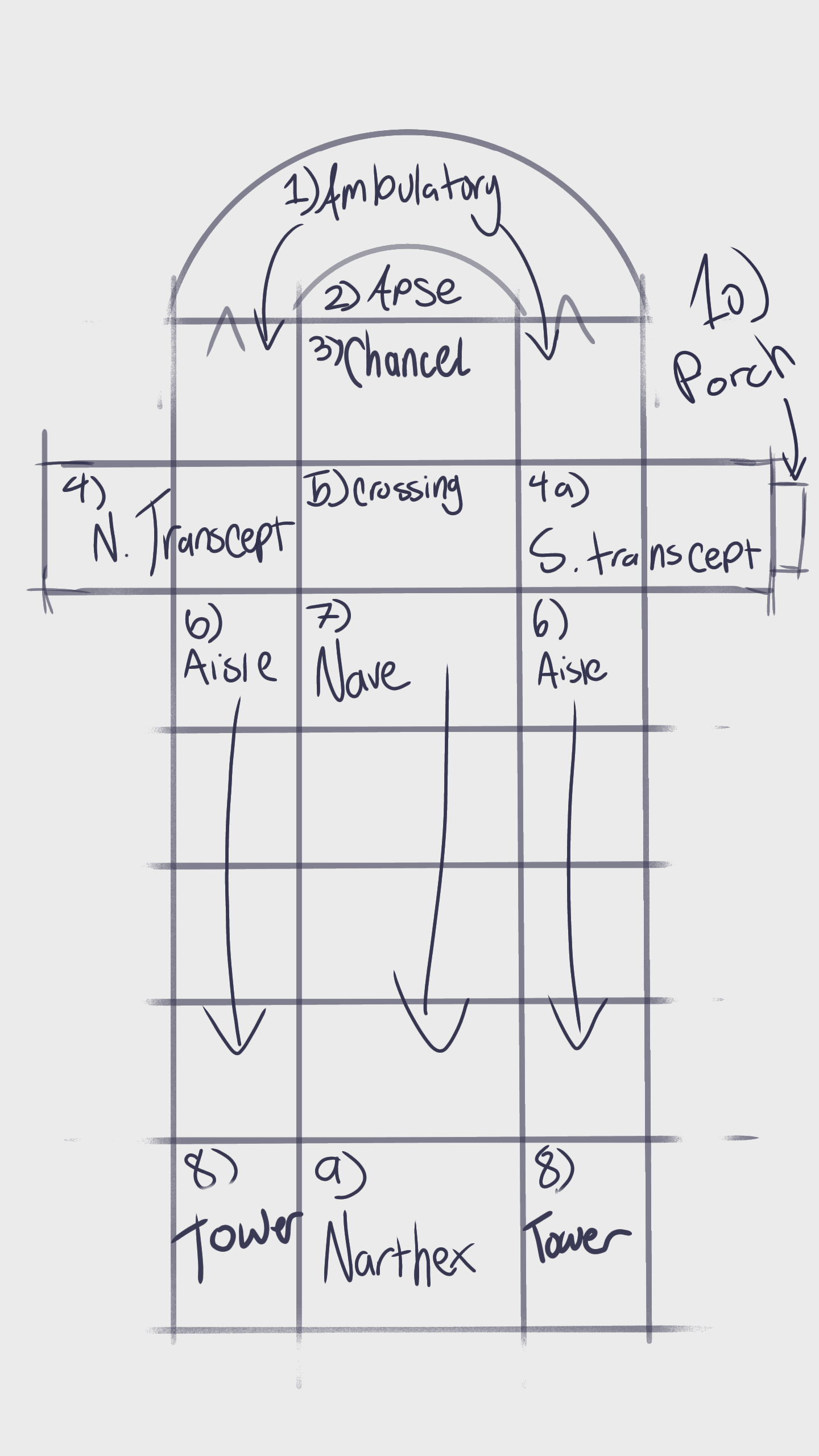 First, lets start with the anatomy of a Cathedral, from the Apse to the Narthex. Cathedrals are laid out to resemble Latin crosses, using the Transepts to form that shape. On the left is a diagram I drew to make it easier to comprehend.
- The Ambulatory is a semicircular archway that serves as the walkway to the Apse. It is connected to the Aisles through the Transept.
- The Apse is a semicircular dome that covers, some of the time, the main Altar. It is usually decorated, alongside the rest of the cathedral.
- The Chancel is the space right next to the Apse, often holding the Choir, or the Sanctuary. It is often connected to the Transepts.
- The Transepts are split into the North and South Transept. They divide the Apse and Chancel from the Nave and Aisles, and serve as either a place to support a spire or towers of some kind. They also often either hold tracery or stained glass and serve a decorational purpose.
- The crossing is the junction of the four parts of a Cathedral. It may hold a tower or dome. In modern Cathedrals, it may hold the Altar.
- The Aisles are not in every church, but in many. They separate the Nave from the walls, and are often adorned in stained glass or tracery.
- The Nave is the rest of the church until you hit the Narthex and Towers. It is the larges space along with being the highest. During worship, it’s often the seating place for people to watch a sermon or what-have-you at the Altar located further down in the Apse. Sometimes it spans the entirety of the Cathedral, and other times it is limited to the center aisle.<
- The Towers are the large towers that adorn the Narthex- or entrance- of a Cathedral.
- The Narthex is an uncommon part of a cathedral, but it often serves as a vestibule with a lower ceiling than the nave.
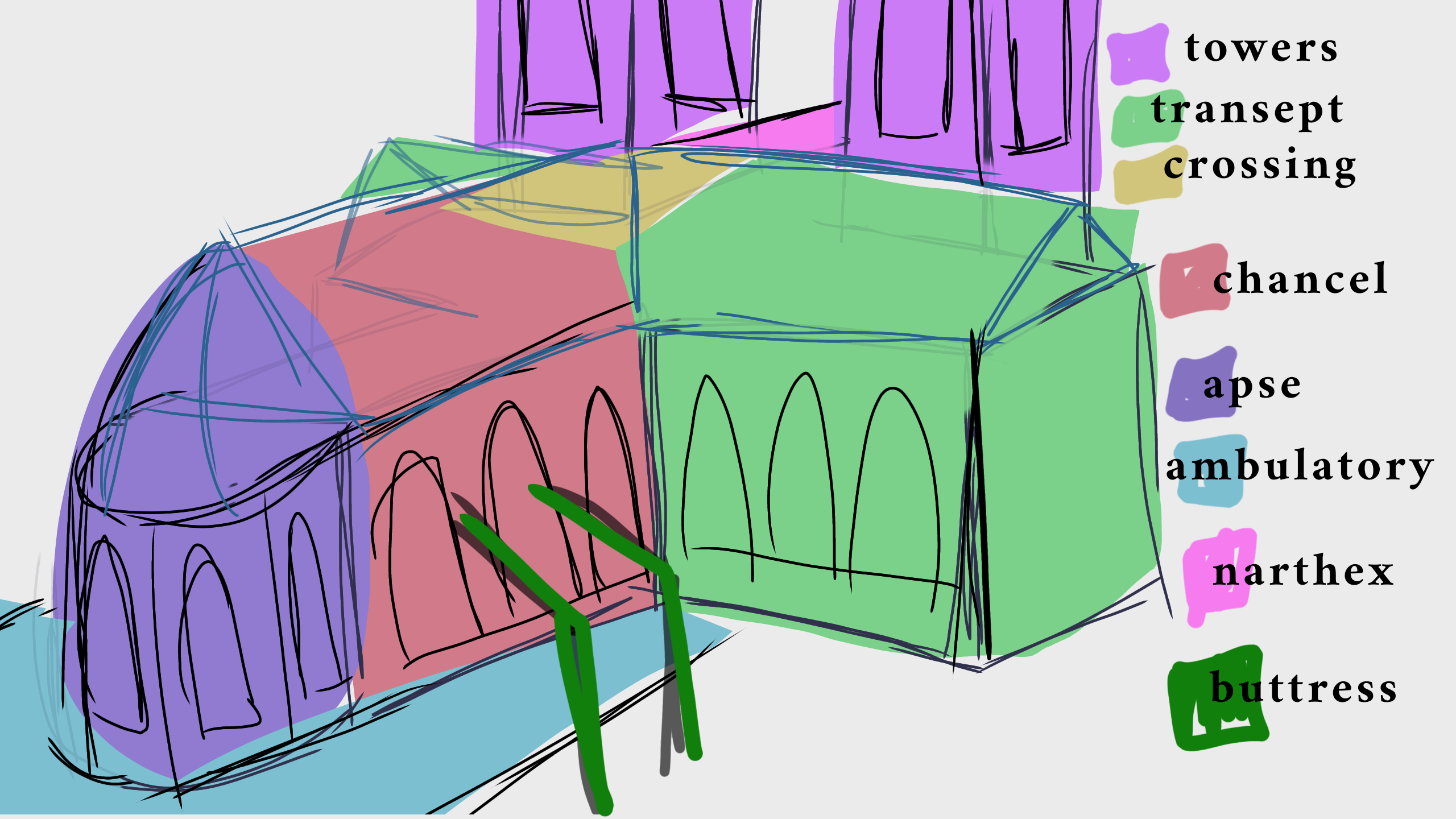
- Not Depicted are Chapels, and the Ambulatory are often lined with Chapels along with the Aisles sometimes containing them. They are a place of prayer and worship that often have their own altar, with may be for Patron saints and other things of the sort.



.png)